
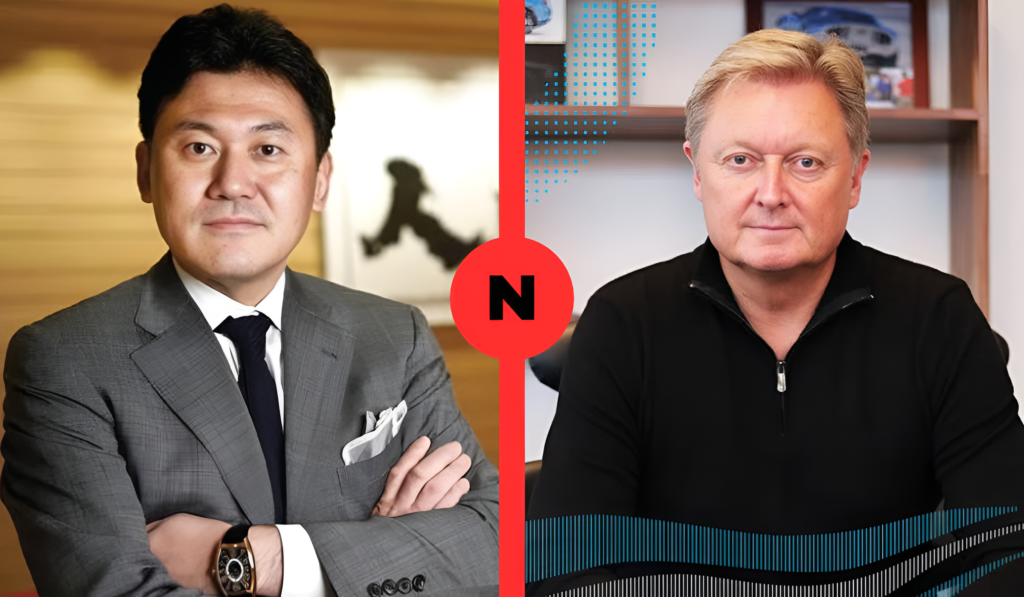
Hiroshi Mikitani and Henrik Fisker are two names associated with ambitious entrepreneurship, global business, and technology-driven change, but their careers could hardly have developed in more different ways. Mikitani built his reputation by creating and expanding Rakuten from a Japanese online marketplace into a group spanning e-commerce, financial technology, digital services, telecommunications, and other businesses.
Hiroshi Mikitani and Henrik Fisker are two names associated with ambitious entrepreneurship, global business, and technology-driven change, but their careers could hardly have developed in more different ways. Mikitani built his reputation by creating and expanding Rakuten from a Japanese online marketplace into a group spanning e-commerce, financial technology, digital services, telecommunications, and other businesses. Fisker came from the world of automotive design, where his name became associated with luxury vehicles before he moved into entrepreneurship and electric-car companies. Their names occasionally appear together in searches, which can lead readers to wonder whether they have worked together, invested in the same company, or shared a formal business relationship. Based on the public corporate records and biographies available, however, there is no widely documented direct partnership between them. The more useful reason to examine Hiroshi Mikitani and Henrik Fisker together is that they represent two contrasting approaches to innovation: one based on building a broad digital ecosystem over decades and another based on product design, automotive disruption, and repeated attempts to create new vehicle businesses.
Who Is Hiroshi Mikitani?
Hiroshi “Mickey” Mikitani is a Japanese entrepreneur best known as the founder of Rakuten Group. According to Rakuten’s official corporate biography, Mikitani joined the Industrial Bank of Japan in 1988, later earned an MBA from Harvard Business School, and founded the company that became Rakuten in 1997. He currently serves as Representative Director, Chairman, President and CEO of Rakuten Group. Over the years, the company expanded far beyond its original e-commerce roots into areas including fintech, digital content, communications, mobile services and other technology businesses. This expansion is important when trying to understand Mikitani’s style as an entrepreneur. Rather than building one isolated product and stopping there, he pursued an ecosystem strategy in which multiple consumer services could potentially reinforce one another under the same wider business group.
Mikitani’s career also reflects a willingness to enter highly competitive industries where established players already dominate. Rakuten’s move into mobile telecommunications is a good example. Rakuten became a mobile network operator in Japan in 2019, placing the group into an industry requiring significant infrastructure, capital, technology, and long-term execution. Mikitani also holds leadership roles in Rakuten Mobile and Rakuten Symphony, illustrating how deeply telecommunications became integrated into the wider Rakuten strategy. This willingness to extend a digital-commerce company into financial services, content, communications, and mobile networks helps explain why Mikitani is often viewed primarily as a platform builder rather than simply the founder of an online shopping company.
Who Is Henrik Fisker?
Henrik Fisker followed an almost opposite path into entrepreneurship. Rather than beginning in finance or digital commerce, he built his reputation through automotive design. Fisker’s own current biography describes him as an automotive designer, serial entrepreneur, adviser and board member, and credits his career with vehicles including the BMW Z8, Aston Martin V8 Vantage, DB9, Fisker Karma and Fisker Ocean. His career began at BMW after his design education, and he later held senior design roles connected with Ford and Aston Martin before moving into businesses bearing his own name.
Fisker’s transition from designer to entrepreneur is central to understanding his career. Designing a successful vehicle and building a successful automobile company are fundamentally different challenges. Automotive manufacturing requires enormous amounts of capital, supplier coordination, engineering, regulatory compliance, production quality, distribution, software support and after-sales service. Fisker repeatedly tried to combine his design reputation with new approaches to electrified vehicles. He co-founded Fisker Automotive and later co-founded Fisker Inc. with Geeta Gupta-Fisker. Fisker Inc.’s own earlier corporate materials described him as CEO and chief designer and presented the company as an asset-light EV manufacturer relying on manufacturing partners while concentrating on design, engineering, technology and customer experience.
Are Hiroshi Mikitani and Henrik Fisker Connected?
The simple answer is that there is no prominent documented direct relationship between Hiroshi Mikitani and Henrik Fisker in the major public biographies and corporate records reviewed for this topic. There is no well-established evidence that Mikitani founded a company with Fisker, served as a Fisker executive, or entered a major publicly documented partnership with him. Similarly, the best-known chapters of Fisker’s career center on automotive design and his own vehicle ventures, while Mikitani’s career centers on Rakuten and the wider digital ecosystem he built around it. Other recent articles examining the same search phrase have reached the same basic conclusion: their names are better understood as a comparison between entrepreneurs than evidence of a specific corporate relationship. USA Vibe
That distinction is especially important for readers arriving through search because two names appearing together online can easily create an impression that a hidden partnership or investment must exist. Search behavior does not prove a relationship. Names can become paired because an article compares them, a database associates similar entrepreneurial profiles, or users simply begin searching for both after encountering them elsewhere. The safest and most useful interpretation is therefore not to invent a link but to examine what their careers have in common and where they sharply diverge.
Mikitani Built an Ecosystem, Fisker Built Around Products
One of the clearest differences between Hiroshi Mikitani and Henrik Fisker is what sits at the center of their business thinking. Mikitani’s career is built around an ecosystem. Rakuten began with online commerce, but the group expanded into credit cards, banking, payments, content, communications, mobile services and other fields. The underlying strategic idea is that one customer can potentially interact with multiple services inside a broader commercial network. Success therefore depends not only on one product but on connecting many businesses and keeping customers engaged across them.
Fisker’s career has been much more product-centered. His reputation was initially built on the physical and emotional qualities of automobiles—the proportions, surfaces, brand identity and visual impact that make a vehicle desirable. Even after becoming a company founder, the product remained central to his public identity. The Fisker Karma and later Fisker Ocean were not simply business platforms; they were vehicles whose appearance, technology and sustainability proposition were central to their marketing. This difference illustrates two distinct entrepreneurial starting points. Mikitani asks how businesses and services can be interconnected into an ecosystem, while Fisker’s career has repeatedly started from the question of how a compelling vehicle can be designed and brought to market.
Their Approaches to Scale Were Very Different
Scale means something different in digital technology than it does in automobile manufacturing. A digital platform may still require major infrastructure and investment, but once built, software and online services can often reach additional users without physically manufacturing an individual product for every new customer. An automobile business faces a much more tangible scaling challenge. Every additional vehicle requires parts, production capacity, logistics, quality control, delivery, servicing and regulatory compliance.
This difference helps explain why comparing Mikitani and Fisker is more interesting than simply listing their achievements. Mikitani’s long-term challenge has been to keep expanding a complex group of interconnected services while competing against large digital, financial and telecom companies. Fisker’s challenge was to translate design vision into industrial production. The second challenge can become especially unforgiving because an attractive product concept does not automatically create a sustainable manufacturing operation.
Henrik Fisker’s EV Ambitions and the Fisker Inc. Bankruptcy
Any current article about Henrik Fisker needs to address what happened to Fisker Inc. rather than stopping with the original promise of the Fisker Ocean. According to the company’s SEC filing, Fisker Group Inc. entered Chapter 11 proceedings on June 17, 2024, and Fisker Inc. and other U.S. subsidiaries commenced Chapter 11 cases on June 19, 2024. The filing formally placed the company and relevant subsidiaries into bankruptcy proceedings in Delaware.
This does not erase Fisker’s earlier influence as a designer, but it changes how his entrepreneurial record should be discussed. Fisker’s story shows that strong branding, compelling design and an attractive EV concept are only part of what determines whether an automotive startup survives. Manufacturing economics, financing, software, supply relationships, service infrastructure and cash management can ultimately be just as important as the vehicle itself. His current personal website now describes him as involved in selective advisory and consulting work rather than seeking operational executive positions, suggesting a different phase in his professional career following the Fisker Inc. period.
Mikitani’s Business Model Has Been More Diversified
Mikitani’s corporate strategy differs significantly because Rakuten has operated across multiple businesses rather than depending on a single flagship physical product. Rakuten’s official materials describe an ecosystem spanning e-commerce, fintech, digital content and communications. That diversity can provide strategic opportunities because businesses may support one another, although it can also make a company much more complex to manage.
Diversification does not remove risk. Entering telecommunications, for example, requires enormous investment and puts the company into competition with established operators. But diversification means business performance is not tied to whether one particular model of car, device, or consumer product succeeds. Fisker’s EV companies, by contrast, operated in a market where the success of a relatively small number of vehicle programs could determine the fate of the entire company. That difference in concentration is one of the strongest contrasts between the two careers.
Innovation Means Different Things for Mikitani and Fisker
Innovation is often used as though it means the same thing in every industry, but these two careers show why that is misleading. For Mikitani, innovation has often involved business models, digital ecosystems, financial technology, communications and the integration of services. Innovation in that context is about building infrastructure and platforms through which customers interact with multiple products.
For Fisker, innovation has often been visible in physical product design and electrification. His career includes work associated with vehicles such as the BMW Z8 and Aston Martin models before he became increasingly associated with electrified and electric cars. His companies also tried new manufacturing and partnership structures rather than simply replicating the traditional vertically integrated automaker model. Fisker Inc.’s 2023 corporate materials, for example, explicitly described its strategy as “asset light,” with manufacturing partners intended to build vehicles while Fisker focused on design, engineering, software and customer experience.
What Their Careers Say About Founder-Led Companies
Both Mikitani and Fisker also illustrate the enormous influence founders can have over company identity. Rakuten is difficult to separate from Mikitani because he founded the business and has remained at the center of its leadership for decades. The Fisker name was even more directly tied to Henrik Fisker because it was literally used as the brand name of his automotive ventures. When founders become closely identified with their companies, their personal reputation can strengthen brand recognition, create a clear vision, and attract customers or investors who believe in that vision.
The trade-off is that founder identity and company identity can become difficult to separate. When things go well, the founder may receive significant credit. When a company faces operational problems, bankruptcy, or strategic setbacks, those events also become part of the founder’s public business record. Fisker’s design achievements and the failure of Fisker Inc. therefore exist within the same broader career story. Likewise, Mikitani’s long tenure means major successes and challenges across Rakuten’s evolution are closely associated with his leadership.
What Entrepreneurs Can Learn From Their Different Paths
The most useful reason to compare Hiroshi Mikitani and Henrik Fisker is not to declare one approach universally superior. Their industries require completely different forms of execution. Instead, the comparison reveals several broader business lessons. A powerful vision is important, but the operational system supporting that vision matters just as much. Product innovation can create attention, but a business still needs financing, distribution, reliable execution and a sustainable economic model. Diversification can create resilience and opportunities for cross-selling, but it also creates organizational complexity. Founder-led companies can move decisively because a strong central vision exists, but they may also become deeply dependent on the judgment of a small group of leaders.
Mikitani’s story demonstrates how an entrepreneur can spend decades expanding from a relatively focused initial business into a much larger ecosystem. Fisker’s career demonstrates both the value of world-class creative ability and the difficulty of turning design leadership into industrial-scale execution. Looking at both together therefore creates a broader picture of entrepreneurship than studying either one in isolation.
Are They Similar Despite Their Different Industries?
There are still meaningful similarities. Both became internationally recognized through fields being reshaped by technology. Both attached ambitious visions to their businesses rather than remaining narrowly focused on traditional industry models. Both also moved beyond their original professional backgrounds. Mikitani began in banking before becoming an internet entrepreneur. Fisker began as a designer before becoming the founder and executive of automotive companies. In both cases, career growth required moving from specialist expertise into broader leadership.
They also share an appetite for large-scale ideas. Building a global digital ecosystem and attempting to establish a new electric-vehicle company are not conservative business ambitions. Both require substantial capital, partnerships, recruitment, brand building and the ability to convince others that a different future is possible. Where their stories diverge is in the execution environment surrounding those ambitions.
Hiroshi Mikitani and Henrik Fisker Today
As of 2026, Mikitani remains firmly embedded in the leadership of Rakuten. Rakuten’s current official leadership page lists him as Representative Director, Chairman, President and CEO, and he continues to hold important leadership roles across businesses such as Rakuten Mobile and Rakuten Symphony.
Henrik Fisker’s current public profile looks different. His personal website presents him as an automotive designer, serial entrepreneur, adviser and board member and says he is currently engaged in selected advisory and consulting roles involving design direction, brand architecture and product strategy. It specifically states that he is not seeking operational executive roles. This marks a noticeable change from the period when he was running Fisker Inc. as chief executive and chief designer. Henrik Fisker
Final Thoughts
Hiroshi Mikitani and Henrik Fisker should not be presented as though they share a major documented business relationship when the public record does not establish one. Their names are much more meaningful together as a business comparison. Mikitani represents long-term ecosystem building across e-commerce, finance, communications and digital services. Fisker represents product-driven innovation, automotive design and the enormous risks involved in trying to turn an ambitious EV concept into a sustainable car company.
Their careers show two very different ways entrepreneurial ambition can develop. One expanded outward from an internet marketplace into an interconnected corporate ecosystem. The other moved from celebrated automotive design into the difficult world of manufacturing and electric-vehicle startups. Both stories involve innovation, risk and founder influence, but the outcomes and operating models demonstrate that having an ambitious idea is only one part of building a durable business.
For anyone searching Hiroshi Mikitani and Henrik Fisker, the clearest answer is therefore not a hidden partnership. It is a contrast between two internationally known entrepreneurs whose careers reveal how differently innovation can look depending on the industry, business model and execution challenge involved.
Also Read: Nora Magazine
















Leave a Comment
Your email address will not be published. Required fields are marked with *