
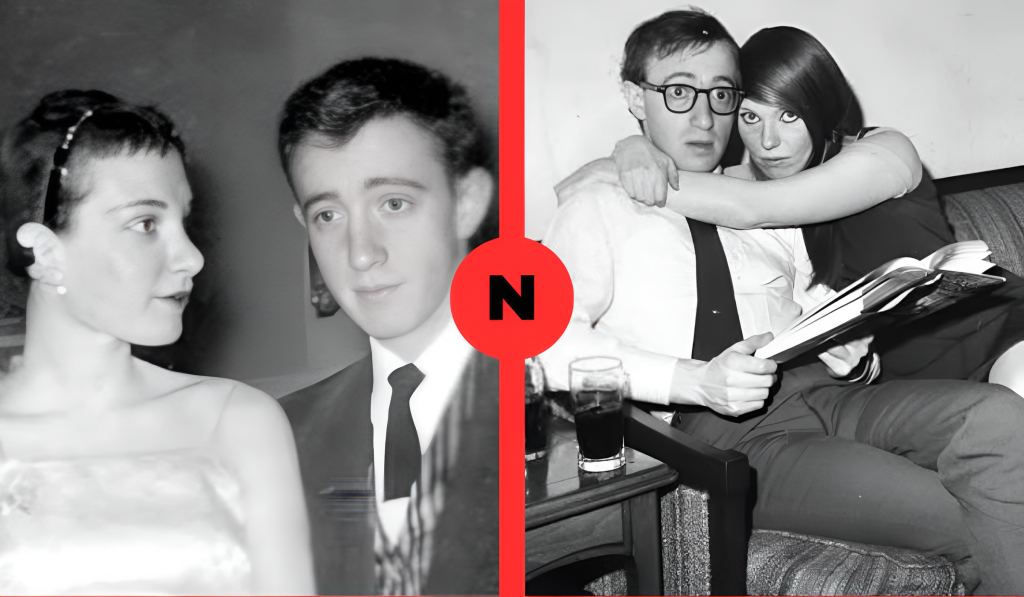
Harlene Rosen occupies an unusual place in Hollywood history. She was never a movie star, never a television personality, and never built a public career around her name. Yet her life became connected to one of the most recognizable filmmakers and comedians of the twentieth century. That connection began before Woody Allen was Woody Allen
Harlene Rosen occupies an unusual place in Hollywood history.
She was never a movie star, never a television personality, and never built a public career around her name. Yet her life became connected to one of the most recognizable filmmakers and comedians of the twentieth century.
That connection began before Woody Allen was Woody Allen in the way audiences came to know him.
In 1956, Allen was still a young comedy writer and performer. Rosen was a teenage philosophy student. The two married in New York’s orbit before Allen’s filmmaking career had properly begun, years before Annie Hall, Manhattan, Hannah and Her Sisters, or the awards and controversies that would eventually define his public image.
Their marriage was brief.
But its impact on Allen’s later public persona was anything but simple.
Rosen became the subject of jokes in Allen’s early stand-up material, and the personal nature of some of those jokes eventually led to a defamation dispute. The episode became one of the most unusual chapters in Allen’s early career because it involved a private former spouse being transformed into material for a comedian whose reputation was increasingly built on personal observations and provocative humor.
Yet there is an important difference between Harlene Rosen’s public history and the enormous amount of information people sometimes expect to find about her.
Very little is known with certainty about her life after the marriage.
She did not become a celebrity in her own right. She largely disappeared from entertainment coverage, leaving later generations to encounter her name mainly through biographies of Woody Allen.
That makes her story less about celebrity and more about what happens when an ordinary private life becomes permanently attached to a famous person’s biography.
Who Was Harlene Rosen?
Harlene Rosen, also recorded as Harlene Susan Rosen, was Woody Allen’s first wife.
She was a philosophy student at Hunter College when she married Allen in 1956. The Guardian describes her as the daughter of a shoe-shop owner whom Allen met through Jewish social clubs in Flatbush and identifies her as a philosophy student.
Other biographical sources describe her as Allen’s childhood sweetheart.
At the time of their marriage, neither person had the public profile associated with their names today.
Allen was still building a career as a comedy writer and performer. He had already demonstrated a talent for jokes, but the major film career had not yet arrived.
Rosen, meanwhile, was a young student.
Their marriage therefore belonged to the earliest chapter of Allen’s adult life.
It took place long before he became an internationally recognized filmmaker.
Her Marriage to Woody Allen Began in 1956
The date most consistently associated with the wedding is March 15, 1956.
A published chronology of Allen’s life records that he moved to Los Angeles to work on The Colgate Variety Show and invited Harlene Rosen to join him as his wife. The chronology states that they married on March 15 before returning to New York after the show ended.
Other established reference sources also record the marriage in 1956. IMDb lists Harlene Susan Rosen as Allen’s first wife and gives the marriage period beginning March 15, 1956.
Allen was around 20 at the time, while Rosen was still a teenager.
That fact has become one of the most frequently repeated details in biographies of their relationship.
But the more interesting historical point is not simply their age.
It is the stage of life in which the marriage occurred.
Allen had not yet become a filmmaker.
He was still finding his professional direction.
Harlene Rosen Was a Philosophy Student
One of the few details about Rosen’s own interests that appears consistently in reputable accounts is her study of philosophy.
The Guardian describes her as a philosophy student at Hunter College.
That detail provides an unusual glimpse into the intellectual environment surrounding Allen during his early adulthood.
Allen later became strongly associated with philosophical questions, existential themes, anxiety, mortality, relationships, and intellectual comedy.
His films frequently explored those subjects.
But he did not initially arrive at that intellectual world through formal academic success.
Several biographical accounts describe him as largely self-educated in literature and philosophy.
His relationship with Rosen formed part of that period of intellectual development. The Guardian notes that after marrying Rosen, Allen arranged for a tutor from Columbia University to guide him through major works of literature and philosophy.
It would be too simplistic to say that Rosen “made” Allen intellectual.
But her own interest in philosophy was part of his environment during an important stage of his development.
Life Before Woody Allen Became Famous
It is difficult for modern readers to imagine the relationship without knowing what Allen’s name would eventually represent.
But in 1956, there was no Annie Hall.
There was no Manhattan.
There was no Academy Award for Best Director.
There was no internationally recognized Woody Allen persona.
Allen was a young comedy professional trying to establish himself.
He had worked as a joke writer and was beginning to move toward performing his own material.
A scholarly biography of American humorists describes Allen’s early career as a joke writer and notes that before turning 20 he had already sold thousands of jokes to New York newspapers. It also identifies Rosen as his 17-year-old philosophy-major wife.
This context changes how the marriage should be understood.
Rosen did not marry an established Hollywood celebrity.
She married someone whose career was still developing.
The Move to Los Angeles
Shortly after the wedding, the couple spent time in Los Angeles because of Allen’s work.
The chronology of Allen’s early career places him there for The Colgate Variety Show in 1956. Rosen accompanied him as his wife before the couple eventually returned to New York.
Los Angeles was already an important center of American entertainment, but Allen’s long-term identity remained strongly connected to New York.
That connection would later become one of the defining characteristics of his films.
New York was not simply a setting for Allen.
It became part of his artistic identity.
Rosen therefore belonged to the period before that identity was fully established.
The Marriage Did Not Last
The marriage eventually broke down.
Sources differ slightly on the exact chronology of the separation and divorce.
IMDb lists the marriage as lasting from March 1956 to November 1962.
Other biographies describe the couple as separating earlier, around 1959, with the legal divorce finalized several years later. A scholarly chronology places the divorce process around 1961–1962.
This distinction is worth preserving rather than forcing one simplified timeline.
The important point is that the relationship itself ended years before Allen’s major filmmaking career began.
Rosen therefore left the marriage while Allen was still in the early stages of becoming a major public performer.
There Were No Children From the Marriage
Harlene Rosen and Woody Allen did not have children together.
That is significant because Allen’s later family history became extensive and highly publicized.
His later relationships and marriages involved children, stepchildren, and adoption, all of which became part of the media record surrounding him.
Rosen’s marriage belonged to an earlier, much smaller chapter.
There were no children connecting her to Allen’s later family life.
That may also help explain why her name largely disappeared from mainstream coverage after the relationship ended.
Rosen Became Part of Allen’s Comedy
The most controversial part of Harlene Rosen’s public story came after the marriage.
Allen increasingly incorporated his personal experiences into his comedy.
That included material about his former wife.
He referred to Rosen with the nickname “the Dread Mrs. Allen” in his stand-up routines. Contemporary retrospective accounts also describe jokes about her appearance, domestic life, and other personal matters.
For a comedian, turning personal experiences into material was part of Allen’s emerging style.
But the material involving Rosen eventually crossed from comedy into a legal dispute.
That made the relationship unusual even by the standards of celebrity biographies.
Why Did Harlene Rosen Sue Woody Allen?
Rosen eventually took legal action over comments Allen made publicly about her.
The most widely documented incident involved jokes connected to a newspaper report about Rosen having been sexually assaulted.
Allen later repeated the joke in interviews and comedy material.
Rosen sued Allen for defamation.
The historical record is generally consistent that the dispute was connected to Allen’s public comments, although details surrounding the legal proceedings vary between later accounts.
The case is important because it demonstrates the limits of turning real people into comedy material.
Allen’s early stand-up depended heavily on observations from his personal life.
Rosen, however, was not simply a fictional character.
She was a private person whose real experiences had been incorporated into a public performance.
That difference became central to the conflict.
The “Dread Mrs. Allen” Era
The nickname itself became part of Allen’s early comedy mythology.
He used “the Dread Mrs. Allen” as a recurring reference to his first marriage.
Later biographies have repeated the phrase because it became closely associated with his early stand-up persona.
But viewed from Rosen’s perspective, the nickname represents something very different.
It meant that a private marriage continued to exist publicly as comedy material even after the relationship had ended.
That tension is one of the most important parts of understanding Rosen’s place in Allen’s history.
She was not simply “the first wife.”
She was also one of the earliest real people whose personal relationship with Allen became part of his professional material.
The Defamation Dispute Became Part of the Historical Record
The dispute is documented in several retrospective accounts of Allen’s early career.
The Guardian describes Rosen as having sued Allen following one particularly offensive joke about the assault report.
Wikipedia’s biography of Allen likewise records that Rosen sued him for defamation over comments made after their divorce.
Academic writing about Allen’s treatment of women in his comedy has also discussed Rosen’s lawsuit as an example of how his personal relationships entered his stand-up material.
The dispute therefore is not merely a modern internet rumor.
It forms part of the documented history of Allen’s early comedy career.
What Did the Lawsuit Mean for Rosen?
It is tempting to make the lawsuit into a simple morality tale.
But the historical record is more complicated.
Rosen was a young woman whose former husband had become a professional comedian.
His career increasingly depended on public performance.
Her private experiences consequently became material she could not fully control.
The lawsuit represented a way of challenging that public treatment.
The precise legal outcome and settlement details are not consistently documented across authoritative sources, so claims about exact settlement amounts or court orders should be approached cautiously.
What is firmly established is that Rosen took legal action over Allen’s public remarks.
That alone makes her role in his biography more significant than the usual “first wife” label suggests.
Her Story Is Mostly Known Through Someone Else
This is perhaps the most important fact about Harlene Rosen.
Almost everything the public knows about her comes through accounts of Woody Allen.
There are few widely available interviews with Rosen herself.
There is no substantial public archive of her later career.
There is no extensive record of her personal opinions about Allen’s films.
And there is no well-documented public career that developed after the marriage.
This means the historical record is inherently unbalanced.
We know a great deal about the person she married.
We know much less about Rosen herself.
That imbalance should be acknowledged rather than hidden.
The Difference Between Harlene Rosen and Later Women in Allen’s Life
Allen’s later relationships received enormous public attention.
Louise Lasser was an actress.
Diane Keaton became an acclaimed actress and filmmaker in her own right.
Mia Farrow was an internationally recognized actress.
Soon-Yi Previn eventually became Allen’s wife.
Rosen was different.
She was not an entertainment celebrity.
She was not an actress.
She did not become professionally connected to Allen’s films.
Her relationship with him occurred before the period in which his private life became a regular subject of celebrity coverage.
That makes her story much quieter.
It also explains why so much of what is written about her focuses on the marriage rather than an independent career.
Did Harlene Rosen Have a Career?
There is no sufficiently reliable public record establishing a long-term professional career for Rosen.
Her education as a philosophy student is documented in multiple accounts.
Beyond that, later career details are difficult to verify.
Some modern biography websites attempt to provide a complete profile, including claims about her professional life and later activities.
However, these details are often repeated without strong sourcing.
A responsible biography should therefore avoid presenting an occupation that cannot be independently established.
The lack of information is not evidence that she did not have a career.
It simply means that her professional life is not well documented in publicly accessible sources.
What Happened to Harlene Rosen After the Divorce?
This is where the public record becomes especially thin.
After the end of her marriage to Allen, Rosen largely disappeared from mainstream entertainment coverage.
She did not build a public career in Hollywood.
She did not become a regular subject of interviews.
She did not maintain a celebrity persona.
As a result, there is no reliable, detailed timeline covering the decades after the divorce.
That absence is important.
Modern websites sometimes fill this gap with precise claims about her later residence, career, family, or financial status.
But a lack of reliable evidence should not be treated as an invitation to guess.
Is Harlene Rosen Still Alive?
Her current status is not reliably established by strong public sources.
Some recent websites speculate about her age and whether she may still be alive, while others provide conflicting claims.
There is no sufficiently authoritative public source confirming her current status.
That means an article about Rosen should not present a definitive answer simply because one celebrity biography website does.
Her long absence from public life makes verification particularly difficult.
The responsible position is to acknowledge the uncertainty.
What Is Known About Her Age?
Some modern sources state that Rosen was born around 1940.
If that estimate is correct, she would have been approximately 16 when she met Allen and 17 when they married.
However, the exact date and place of birth are not firmly established by the strongest sources available.
The well-documented part is her age at the time of the marriage.
Biographical and historical sources consistently place her as a teenager when she married Allen.
That is more defensible than presenting an exact birth date as fact.
Harlene Rosen’s Connection to Philosophy
Her interest in philosophy remains one of the few personal details that survives clearly in historical accounts.
It is more than an incidental fact.
Allen’s later body of work repeatedly returned to philosophical questions.
His characters wonder about death, morality, relationships, God, meaning, chance, guilt, and the nature of existence.
His early relationship with Rosen occurred during a period when he was beginning to educate himself more deeply in literature and philosophy.
The Guardian notes that Allen hired a Columbia tutor to help him work through major literary and philosophical texts after marrying Rosen.
An academic discussion of Allen’s work similarly identifies Rosen as a philosophy student during this formative period.
It would be impossible to measure precisely how much influence she had on his intellectual development.
But her own academic interest was clearly part of the environment in which his intellectual identity was taking shape.
The Marriage Happened Before His Film Career
Timing is essential when discussing Rosen.
Allen did not direct his first major films while married to her.
His transition into filmmaking came later.
His first film as director, Take the Money and Run, arrived in 1969, years after the marriage had ended.
By then, Rosen had already been separated from the world of Allen’s professional development for a significant period.
This makes her part of the pre-Hollywood chapter of his biography.
She knew him when he was a young comedy writer and performer rather than the filmmaker associated with dozens of films.
That is a very different version of Woody Allen from the one later audiences knew.
Harlene Rosen and the Evolution of Allen’s Comedy
Allen’s comedy changed substantially over the course of his career.
His early stand-up was more direct and personal.
He often used autobiographical material, exaggerated his experiences, and constructed jokes around relationships and neuroses.
Later, his films became more sophisticated in structure and theme.
The transformation from stand-up comic to filmmaker is one of the defining arcs of his career.
Rosen belonged to the earliest part of that transformation.
Her marriage occurred while Allen was still discovering the comic voice that would eventually become internationally recognizable.
And because he later mined the relationship for jokes, Rosen became indirectly connected to that development.
Why Harlene Rosen Remains Relevant
At first glance, a short marriage from the 1950s might seem like an insignificant footnote in a career spanning decades.
But Rosen’s story remains relevant for several reasons.
First, she was present during the formative years of Allen’s career.
Second, her education and intellectual interests intersected with the intellectual direction Allen would later explore through his writing and films.
Third, their divorce produced one of the most documented conflicts in his early stand-up career.
And finally, her story raises a broader question about celebrity biographies:
What happens to a private person when someone close to them becomes famous?
Rosen never sought the kind of public identity that Allen eventually acquired.
Yet her name became permanently attached to his.
Harlene Rosen Was Not a Hollywood Actress
This distinction is worth repeating because celebrity biographies frequently blur it.
Rosen did not have the entertainment career that later women associated with Allen had.
She was a student when they married.
She did not appear as one of Allen’s film stars.
She did not become part of his professional filmmaking circle.
Her significance comes almost entirely from the personal history surrounding his early life.
That makes her biography unusual.
She is a recognizable name in film history without actually having a film career.
Why There Is So Little Information About Her
The answer is relatively straightforward.
Rosen’s marriage to Allen ended before the internet, before modern celebrity culture, and before personal social-media accounts made it possible for private individuals to document their lives publicly.
After the legal dispute, she did not maintain a prominent entertainment profile.
Meanwhile, Allen continued working.
He made films.
He gave interviews.
He published books.
He appeared on television.
His career generated thousands of pages of documentation.
Rosen’s did not.
Over time, the information imbalance became enormous.
Today, someone searching for Harlene Rosen is likely to encounter dozens of pages about Woody Allen before finding anything genuinely about her.
Frequently Asked Questions About Harlene Rosen
Who is Harlene Rosen?
Harlene Rosen, also known as Harlene Susan Rosen, was Woody Allen’s first wife. She was a philosophy student when they married in 1956.
When did Harlene Rosen marry Woody Allen?
Rosen and Allen married on March 15, 1956, according to biographical chronologies and reference sources.
How old was Harlene Rosen when she married Woody Allen?
Sources consistently describe Rosen as 17 at the time of the marriage, while Allen was about 20.
What did Harlene Rosen study?
She was a philosophy student at Hunter College.
Did Harlene Rosen and Woody Allen have children?
No. They did not have children together.
How long were Harlene Rosen and Woody Allen married?
Their marriage began in 1956 and ended after a relatively short period. Sources differ on whether to describe the relationship as ending in 1959 or to use the later legal divorce date of 1962.
Why did Harlene Rosen sue Woody Allen?
She took legal action over public comments Allen made about her after their relationship ended. The dispute was connected to jokes he incorporated into his comedy.
Did Woody Allen use Harlene Rosen in his comedy?
Yes. He repeatedly referred to his former wife in early stand-up material, including using the nickname “the Dread Mrs. Allen.”
Was Harlene Rosen an actress?
There is no strong evidence that she had an acting career. Her documented background identifies her as a philosophy student rather than an actress.
What did Harlene Rosen do after her divorce?
Very little of her later professional or personal life is reliably documented in public sources.
Is Harlene Rosen still alive?
Her current status is not reliably confirmed by strong public sources. Claims on newer biography websites conflict, so a definitive answer would be speculative.
What is Harlene Rosen’s net worth?
There is no reliable public information establishing her personal net worth.
The Woman Behind the Footnote
Harlene Rosen’s place in history is unusual because her name survived while much of her life did not.
She married a young comedy writer before he became an internationally famous filmmaker.
She studied philosophy while Allen was beginning to develop his own intellectual interests.
She moved with him to Los Angeles during one of the earliest stages of his professional career.
Then the marriage ended.
Allen’s career continued to expand, while Rosen gradually disappeared from public view.
But her name remained embedded in biographies of the man she had married.
That is why writing about Harlene Rosen requires a different approach from writing about a conventional celebrity.
There is not enough reliable evidence to construct a detailed modern celebrity profile of her.
There is, however, enough historical material to understand the significance of her relationship with Allen.
She belonged to the years before the films, before the awards, and before the global reputation.
She was part of the young man’s life before he became the famous filmmaker.
And when their marriage ended, she became an unexpected character in the comedy that followed.
The most responsible way to tell her story is therefore not to fill the gaps with speculation.
It is to recognize those gaps.
Harlene Rosen was a private woman whose name became public because of a famous marriage. Her own voice is much harder to find in the historical record than the voice of the comedian who later wrote jokes about their relationship.
That imbalance is perhaps the most revealing part of her story.
She was never famous for being famous.
She became known because someone else became famous.
And more than six decades later, that distinction still defines how the world encounters her name.
Also Read: Nora Magazine













Leave a Comment
Your email address will not be published. Required fields are marked with *